
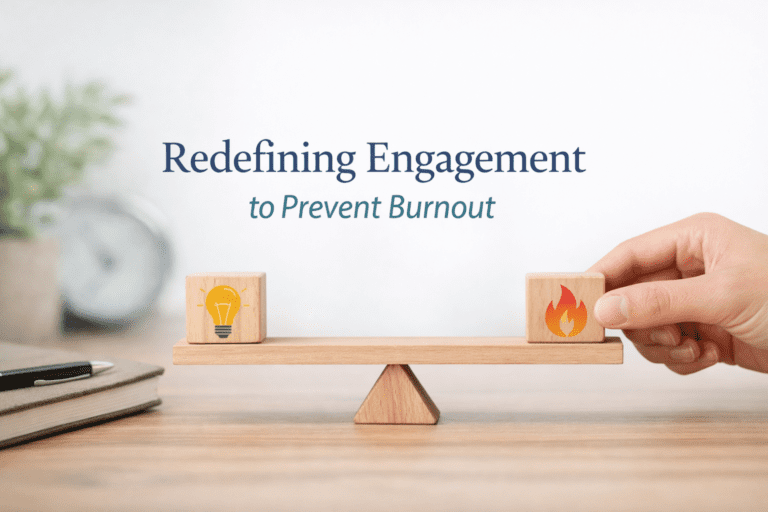
At this time of year, almost no one says they’re burned out.
They say they’re busy.
Leaders are busy.
Teams are busy.
Calendars are full. Goals are moving. Responses are quick.
On the surface, it looks like engagement.
But if we want to prevent burnout, we have to redefine what engagement actually means.
If busyness is your definition of engagement, burnout will eventually follow.
Somewhere along the way, we absorbed the idea that strong leadership means sustaining constant intensity. If people are responsive, proactive, and stepping up, we assume things are healthy.
But engagement doesn’t reveal itself through calendar volume.
Engagement shifts with capacity, life season, clarity of goals, and emotional load. When leaders treat busyness as proof of commitment, they risk rewarding intensity without examining sustainability.
And that’s often where burnout begins. When responsiveness becomes the standard, sustainability quietly disappears.
Engagement is not how much someone does. It’s how sustainably they can contribute.
In coaching conversations, engagement rarely shows up as “fully in” or “checked out.”
There are employees who thrive on stretch and visibility.
There are steady contributors who deliver excellent work within clear boundaries.
There are people whose engagement fluctuates depending on clarity, role alignment, or season of life.
All of that can be healthy.
What becomes risky is when leaders — or those training leaders — implicitly push everyone toward maximum intensity.
Especially during already busy seasons.
Medium engagement is not failure.
Steady contribution is not disengagement.
Boundaries are not a lack of care.
In fact, steady contribution is often the most sustainable form of engagement.
If we want to redefine engagement to prevent burnout, we have to make it practical.
That means shifting from measuring activity to examining alignment and capacity.
Instead of asking:
Who is stepping up the most?
Who is responding the fastest?
Leaders can begin asking:
Is this pace sustainable for this person?
Who consistently absorbs ambiguity or extra work?
Are we praising responsiveness more than resilience?
What would right-sized engagement look like here?
For those who coach or train leaders, this means helping them expand their definition of engagement — and notice what their culture rewards.
Because prevention doesn’t start when someone collapses. It starts when leaders begin recalibrating what “good” looks like.
In mission-driven environments especially, busyness can feel virtuous. When the work matters, stepping up feels noble.
But sustainability is what protects the mission long-term.
If engagement is defined by how full the calendar looks, burnout becomes inevitable.
If engagement is defined by aligned, durable contribution, momentum can last.
Redefining engagement isn’t a philosophical shift. It’s a leadership practice.
And it’s one of the most practical ways to prevent burnout before it ever becomes visible.
If this conversation resonates, it’s likely because you’re seeing some version of it on your own team.
In The Burnout Prevention Workshop, we explore how leaders can recognize early warning signs, shift what they praise, and create sustainable engagement — not just visible intensity.
Preventing burnout doesn’t require less ambition.
It requires more intentional leadership.
👉 Learn more about The Burnout Prevention Workshop